
Rhema Study - AI-Powered Bible Study Platform
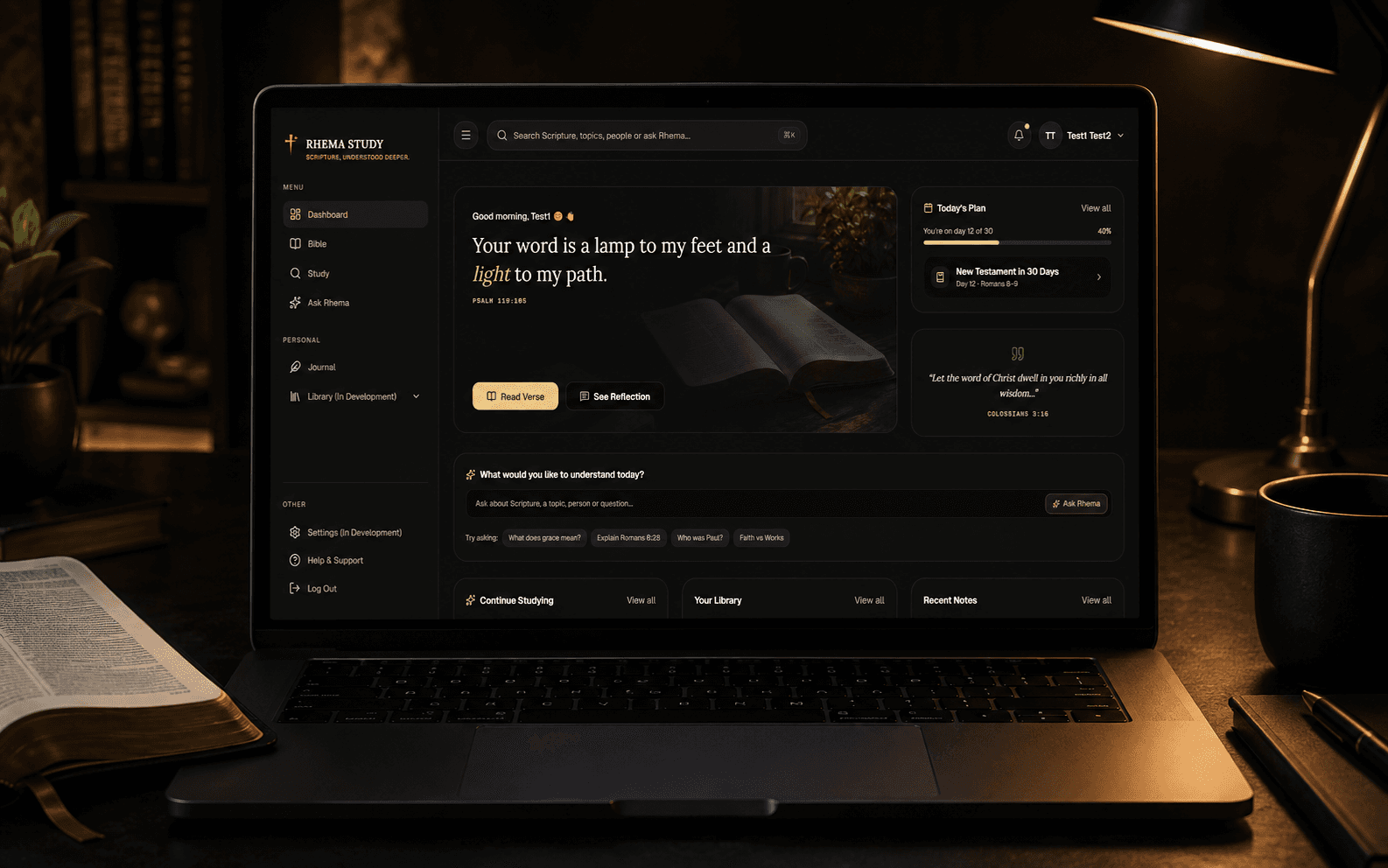
Rhema Study is a Bible study platform designed to make deeper Scripture study feel focused, personal, and accessible. Instead of switching between a Bible app, search engines, notes, journals, and general-purpose AI tools, users can read Scripture, explore its context, ask questions, save meaningful passages, and reflect on what they are learning within one connected experience.
How We Started
Studying the Bible deeply can quickly become a fragmented experience. A user may read a passage in one app, search elsewhere for context, open another resource for cross-references, keep notes somewhere else, and use a general AI chatbot when they have questions. Rhema Study started with the idea of bringing those parts of personal Bible study together without allowing technology to become the focus. The goal was to create a calm, connected study environment where Scripture remains central and technology simply helps users understand, organise, and continue what they are learning.
Project Process
Understanding the Study Experience
The first step was defining what someone actually needs during personal Bible study. Rather than starting with AI features, the experience was mapped around a natural journey: read a passage, select something meaningful, understand what it means, explore its context, ask further questions, save what matters, and reflect privately. This became the foundation for the Bible reader, Study workspace, Ask Rhema, personal library, and journal.
Designing AI Around Scripture
AI could make studying faster, but it also introduced an important trust problem: users should never confuse an AI-generated explanation with Scripture or spiritual authority. Rhema was therefore designed as a study assistant rather than an answer-giving authority. The experience encourages users to return to the biblical text, separates explanation from reflection, avoids claims such as 'God is telling you', and acknowledges uncertainty where an interpretation is legitimately debated.
Creating a Deeper Study Experience
When a user selects a verse and chooses to study it, Rhema turns that passage into a structured study rather than returning a large block of AI-generated text. Users can explore the meaning of important phrases, immediate and literary context, historical background where appropriate, the central theme, related Scripture, Christ-centred connections, illustrations, and reflection questions. This makes deeper study easier to navigate without overwhelming the user.
Making Scripture Connections More Trustworthy
Cross-references are especially useful when studying Scripture, but allowing an AI model to freely generate Bible references creates the risk of inaccurate or invented citations. To make this experience more dependable, Rhema retrieves established cross-reference candidates from an external biblical dataset and asks the AI to explain the relationship between those passages. The technical implementation uses HelloAO's Open Cross Reference data and backend validation, but the user simply receives relevant Scripture connections they can explore for themselves.
Building a Personal Study Space
Bible study is not only about receiving information; users also need somewhere to keep what they discover. Rhema includes saved Scripture, notes, journal entries, and persistent Ask Rhema conversations so a study does not disappear when the session ends. The aim is for the platform to gradually become a personal record of passages, questions, insights, and reflections that the user can return to over time.
Designing for Privacy & Trust
Some of the most meaningful reflections people write during Bible study can also be deeply personal. Privacy therefore became a product requirement rather than an afterthought. Accounts and personal resources are protected through authenticated access, while private journal content is encrypted using AES-256-GCM before being stored. This allows Rhema to offer personal study features while treating the user's private reflections with appropriate care.
Building for Real-World Use
The platform was built as a full-stack application with Next.js on the frontend and ASP.NET Core on the backend, with PostgreSQL handling persistent user data. The AI architecture was also designed so different providers can be used without rebuilding the product. Local development initially used Ollama, while Groq was introduced for production to reduce the time users spend waiting for a study to generate.
Key Features
Read & Explore Scripture
Users can move through books and chapters, select passages, change supported translations, and move naturally from reading into deeper study without leaving the experience.
AI-Assisted Bible Study
Selecting a passage can generate a structured study that breaks down its meaning, important phrases, themes, context, Scripture connections, and questions for personal reflection.
Understand the Context
Literary, immediate, and historical context help users understand not only what an individual verse says, but where it sits within the surrounding passage and wider biblical narrative.
Explore Related Scripture
Relevant cross-references help users compare Scripture with Scripture and continue exploring themes beyond the passage they originally selected.
Ask Rhema
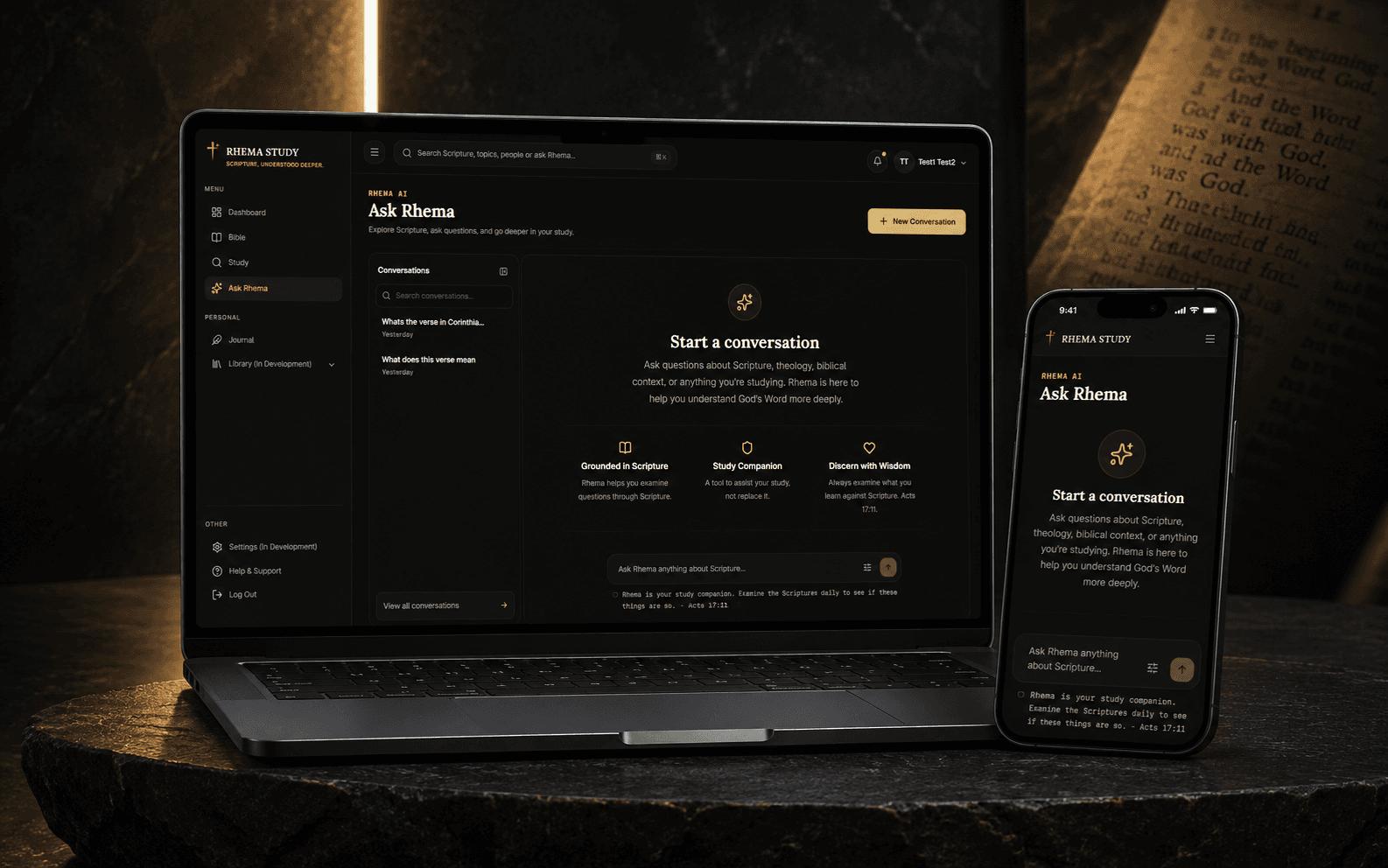
Users can ask questions while studying and continue the conversation when something needs further explanation. Conversations can be revisited later, allowing questions to become part of an ongoing study rather than a one-time interaction.
Save What Matters
Meaningful passages can be saved to a personal library, making it easier for users to return to Scripture they want to remember, study further, or reference later.
Private Personal Journal
Users can write and revisit personal reflections in a dedicated journal. Entries are encrypted before storage so sensitive reflections are not kept as readable plaintext in the database.
Personal Study Experience
Saved content, conversations, journal entries, and study activity are connected to the user's account, creating a study environment that can continue across sessions rather than resetting every time they return.
Designed for Different Screens
The interface is responsive across desktop and mobile layouts so users can move between focused study at a computer and everyday Scripture reading on a smaller device.
Project Outcomes & Results
Combined Bible reading, deeper study, AI-assisted questions, saved Scripture, and personal reflection into one connected experience.
Created a structured study experience that turns complex biblical context into clear, navigable sections instead of overwhelming users with a single AI response.
Designed AI safeguards that keep Scripture central and clearly separate biblical text from generated explanation and reflection.
Improved the reliability of AI-assisted cross-references by grounding Scripture connections in retrieved biblical data rather than allowing the AI to freely invent references.
Created a private study environment where users can preserve saved passages, conversations, notes, and encrypted journal reflections over time.
Reduced production AI response times by moving from local inference to a faster production AI provider while preserving the same study experience.
Built the foundation for a cross-device personal Bible study experience that can continue growing with additional study and personalisation features.
Conclusion
Rhema Study started with a simple product question: how can technology make deeper Bible study easier without becoming a distraction from Scripture itself? The result is a connected study environment where users can move naturally from reading a passage to understanding its context, exploring related Scripture, asking questions, saving what matters, and reflecting privately. Behind that simple experience is a full-stack system built with Next.js, ASP.NET Core, PostgreSQL, secure authentication, encrypted personal content, external Scripture data, and a provider-independent AI architecture. The project demonstrates not only how AI can be integrated into a product, but how product design, trust, privacy, user experience, and engineering decisions can work together to solve a meaningful user problem.